
Pregnancy · Birth preparation
“Big Baby” on Ultrasound? What the Evidence Actually Says
Your baby is not a number. Third-trimester weight estimates can be off by about 15% in either direction—here’s what a “big baby” prediction really means for shoulder dystocia, induction, cesarean, and your birth plan.
Picture it. You’re 36-ish weeks pregnant, ultrasound goo on your belly, feeling kind of pleased with yourself because HEY, I’ve grown a baby! I’m almost there! And then someone says, “Looks like a big one!” Or the tech goes quiet. Or a number pops up on the screen that feels uncomfortably greater than 50%.
And just like that, you’re doing math on how a nine-pound human leaves a body, and the Google rabbit hole is calling your name.
Let me save you some tabs. (I know. You were already fourteen deep.)
Key takeaways
The Short Version
- Third-trimester ultrasounds are decent at giving a ballpark weight and not great at predicting an actually big baby.
- Estimates can be off by about 15% in either direction.
- Big babies do have a higher chance of shoulder dystocia, but most cases are handled without lasting harm. AND in at least half of the shoulder dystocias that happen, the babies are NOT big.
- Induction may lower the chance of shoulder dystocia and fractures, but it hasn’t been shown to prevent nerve injuries. Planned cesareans would take thousands of surgeries to prevent a single permanent injury.
- The suspicion of having a “big baby” can change your care, sometimes more than the baby’s actual size does.
- Diabetes changes the math, so if you have it, keep reading.
The longer, science-y version
What Counts as a “Big Baby”?
It depends on who you ask, which is the first clue that this is more of an art than a science. Macrosomia usually means a baby born over 4,000 grams (8 lbs 13 oz) OR over 4,500 grams (9 lbs 15 oz). Large for gestational age (LGA) means a baby who is born above the 90th percentile for their gestational age—so you could technically have a 7-pound baby who is LGA if they are born early enough.
And here’s something that might be surprising: big babies aren’t rare. In the U.S., among people without diabetes who gave birth at 39 weeks or later, about 8.8% of babies weighed 4,000 to 4,499 grams, and about 1.2% weighed 4,500 grams or more. With gestational diabetes, it’s about 9.4% and 3.1%. (Those numbers come from Evidence Based Birth’s review of U.S. birth data.)
So lots of people are walking around with babies that size, and lots of those babies are born just fine.
How Accurate Is Ultrasound at Estimating Baby’s Weight?
Honestly? Meh.
Ultrasound doesn’t actually weigh your baby. It measures a few body parts (head, belly, thigh bone) and plugs them into a formula. And the formula’s margin of error is generous: estimates are usually within about 15% above or below the real weight. Let’s make that concrete. If your baby is actually going to weigh 7½ pounds, the estimate could land anywhere from 6 lbs 6 oz to 8 lbs 10 oz. That’s a two-and-a-quarter-pound window!
A personal example of how off ultrasound (and even experienced obstetric providers) can be: my OB provider felt like my uterus was measuring small—you know, the tape measure across your belly at office visits. I was sent to ultrasound, and it guessed my baby at around the 30th percentile at about 37 weeks. He was over 9 pounds and technically “LGA” when he was born at 41 weeks. Side note: I had my smallest perineal tear with that baby! Far smaller than with my 6 pound 12 ounce baby.
When researchers look at how often a “big baby” prediction turns out to be right, the results are humbling:
- As wrong as they are right. Across 14 studies, ultrasound predictions of a baby over 4,000 grams were right anywhere from 15% to 79% of the time, and mostly less than half. For babies over 4,500 grams, accuracy was 22% to 37% (from a review by Chauhan and colleagues).
- Feeling the belly isn’t better. Clinical estimates by hand land in about the same neighborhood, 40% to 53%.
- Misses and false alarms. A 2024 study in the American Journal of Obstetrics and Gynecology looked at 26,527 pregnancies in the UK. The scan flagged about 65% of the babies who ended up LGA—it missed roughly 1 in 3. For people scanned specifically because someone suspected a big baby, the scan was right about half the time (50.3%), and roughly 1 in 3 babies who were NOT large still got flagged as large.
- Timing matters. A 2025 review of third-trimester scanning in Archives of Gynecology and Obstetrics summarized one large study where a scan at 35 to 37 weeks caught 46% of LGA babies, while scans done within 10 days of birth caught 71%. Scans done earlier, at 31 to 33 weeks, did even worse.
To be fair to ultrasound, it’s not useless. It’s more accurate in pregnancies with diabetes, partly because big babies are simply more common in moms with diabetes. And it’s better at ruling a big baby OUT than ruling one in. But “this baby is big” is a guess, not a verdict.
Why Does Anyone Care? Shoulder Dystocia
This is the main worry behind the whole conversation, so let’s talk about it without panic and without sugarcoating.
Shoulder dystocia is when the baby’s head is out and a shoulder gets stuck behind the pubic bone. It’s an emergency that care providers train for, and in most cases it’s resolved with no harm to the baby. The risk goes up with size:
- Babies under 4,000 grams: about 1%
- 4,000 to 4,499 grams: about 5% to 9%
- 4,500 grams and up: about 14% to 23%
The nerve injury people fear (brachial plexus injury) happens in a small fraction of those, and most of them heal. Among people without diabetes, permanent nerve injury is estimated at about 1 in 555 for babies between 8 lbs 13 oz and 9 lbs 15 oz, and about 1 in 175 for babies 9 lbs 15 oz or larger. What else has a probability of roughly 1 in 550? Having 9 sons IN A ROW.
At least half of shoulder dystocia cases happen in babies who are NOT big.
It can happen with any size baby, which is why “big” is a lousy predictor all by itself.
How Does Diabetes Change the Picture?
Diabetes changes the numbers, and I’d rather you hear it from me than discover it at 2 a.m. on a forum.
In one often-cited study by Rouse et al., among people without diabetes, shoulder dystocia happened in about 6.7% of babies weighing 8 lbs 13 oz to 9 lbs 15 oz, and 14.5% of babies over 9 lbs 15 oz. When mothers had diabetes, those numbers were 13.9% and 52.5%. High blood sugar may change how a baby grows, so shoulders can be broader relative to the head—which means shoulder dystocia can happen even when the baby isn’t especially big.
The good news is that managing blood sugar matters. When gestational diabetes is treated with diet, exercise, or medication, the rate of big babies drops. And because the stakes are different, the conversation about a suspected big baby is different too. ACOG says providers should discuss the pros and cons of cesarean when the baby of someone with gestational diabetes is suspected to weigh 4,500 grams or more, while also acknowledging that there isn’t enough data to say whether cesarean prevents birth injuries.
Isn’t There Normal Genetic Variation in Baby Size?
Honestly, in my own practice, this bothers me to no end—and not just when the baby is in utero!
Here’s my own example: I also had a baby who was flagged as “small.” Rightly, my providers followed her closely (she came out at the 4th percentile at 41 weeks), and she had lots of ultrasounds. What the ultrasound report did NOT take into consideration was my 4’11” mother-in-law, my two aunties who may claim on their licenses that they are 5’, and other genetically “small” people in the gene pool. Those ultrasounds ended up being largely accurate about her size—but it bears mentioning that all our different women-bodies grow differently sized baby-bodies. That baby girl is now 13 years old and is STILL hovering around the 4th percentile. Somebody’s gotta do it!
In fact, several studies have shown that variation in fetal growth between and within countries does exist—even when as many variables as possible are removed.
Choose your own adventure
What Are the Options for a Suspected Big Baby?
As a kid, I loved to read those “Choose Your Own Adventure” books. In obstetrics, it’s pretty rare that there is ONE path to take. With a suspected big baby there are (at least) three basic roads, all with pros and cons.
- 1Planned cesarean. A classic analysis from 1996 estimated that for people without diabetes, you’d need nearly 3,700 unnecessary cesareans to prevent ONE case of permanent nerve injury when the baby was suspected to be 9 lbs 15 oz or more. Yes, that study is about 30 years old (ancient history, back when we all listened to the dial-up internet screech), but nothing newer has overturned the basic message: surgery isn’t free of risk, for you now or in future pregnancies. The American College of Obstetricians and Gynecologists (ACOG) says a planned cesarean “may be considered” at an estimated weight of 11 pounds (5,000 grams) without diabetes, or 4,500 grams with diabetes.
- 2Induction. In the Cochrane review (about 1,200 people without diabetes, induced at 37 to 38 weeks versus waiting), induction may lower shoulder dystocia from about 7% to 4% and birth fractures from about 2% to 0.4%. It did NOT show a difference in nerve injuries, cesarean rates, or NICU admissions. And there were trade-offs: more babies needing treatment for jaundice (11% versus 7%) and possibly more severe perineal tears for mom. ACOG’s guidelines call for more research before recommending induction for a suspected big baby—especially given how off we are at guessing whether babies will be big!
A newer study, the Big Baby Trial (2025, nearly 2,900 people, induction at 38 weeks versus standard care), found shoulder dystocia in 2.3% versus 3.1%. That difference wasn’t statistically significant in the main analysis. The trial stopped early because shoulder dystocia is so rare that they would have needed more than 12,000 people to prove the point. That’s the story of this whole topic: the thing we’re trying to prevent is uncommon, which makes it very hard to study. - 3Wait and see, with a plan. This is not the same as “do nothing.” It means going into labor with a team that knows what to do if a shoulder gets stuck. Training in managing shoulder dystocia has been shown to reduce permanent injury, and that’s worth asking about, since babies of EVERY size can have a shoulder dystocia.
The Sneaky Part: A “Big Baby” Label Can Change Your Care
Here’s what I really want you to take away. Obstetric providers aren’t blinded to the estimate. Across ten studies from 1992 to 2024 that Evidence Based Birth reviewed, and especially from the Listening to Mothers Survey published in 2026 by Sakala et al., it’s the suspicion of a big baby, not the actual size, that tends to drive more inductions, more cesareans, and more diagnoses of “stalled” labor. A few examples:
- In a 2024 study, cesarean rates were 17% when a big baby was suspected, versus 10.5% when it wasn’t—even among babies who actually were big.
- In another study, when a baby’s weight was overestimated by more than 15%, cesarean for “stalled labor” was 35%, compared with 13% when it wasn’t.
- In a randomized trial of 13,046 low-risk pregnancies in the Netherlands (the IRIS trial, which was looking for small babies), routine third-trimester scans led to more inductions of labor and no drop in serious newborn complications.
In other words, a number on a screen can turn into a self-fulfilling prophecy. Labor gets a shorter leash. Patience gets a little thinner. The clock gets a little louder. The label comes with you to the labor room.
None of this means big babies never cause problems. They can, and shoulder dystocia is real. But a guess that’s wrong about half the time shouldn’t be allowed to steer the ship.
Bring this list
Questions to Ask Your Provider About a Big Baby Estimate
Take this list in with you. (You’re allowed to bring a list. Also, snacks.)
- 1How accurate is this estimate, and what’s the possible range?
- 2If the baby is actually 7 pounds versus 9 pounds, would our plan change? If not, does the scan actually help us?
- 3What’s your usual approach to a suspected big baby? Is one of the three roads above their standard?
- 4Does your team train regularly for shoulder dystocia? Training matters for every baby, not just the big ones—and when teams train for emergencies, they have better outcomes.
- 5If I have gestational diabetes: how are my blood sugars, and how do they affect this plan?
And if you want something to DO with your nervous energy: managing blood sugar if you have diabetes, and moving your body in ways that feel good, are both linked to lower odds of a big baby. (Fifteen randomized trials found exercise during pregnancy reduced big-baby risk.) That’s not a promise, just a place to put your energy if that feels good. For more on getting ready for birth, see our complete guide to prenatal classes.
So Here’s the Deal
An ultrasound estimate is one piece of information. It’s a weebly-wobbly piece, with a massive margin of error. It deserves to be heard, not worshipped.
Big babies and shoulder dystocia are real, and for people with diabetes especially, the conversation deserves thoughtfulness. But for most of us, the biggest risk of a “suspected big baby” isn’t the baby. It’s a chain of interventions set off by a number that’s off about half the time.
Your body has done a LOT of work to get here. Ask good questions, make a plan with people who listen, and give yourself grace when the estimate turns out to be wrong in either direction.
You and your baby are not a number on a screen.
Common questions
Frequently Asked Questions About Big Baby Ultrasounds
How accurate is an ultrasound at estimating my baby’s weight?
Third-trimester ultrasound estimates are usually within about 15% above or below the baby’s actual weight. For a baby who will weigh 7½ pounds, that means an estimate anywhere from about 6 lbs 6 oz to 8 lbs 10 oz. Predictions of a baby over 4,000 grams have been right anywhere from 15% to 79% of the time across studies, and mostly less than half the time.
What weight is considered a “big baby”?
Macrosomia usually means a baby born over 4,000 grams (8 lbs 13 oz) or over 4,500 grams (9 lbs 15 oz), depending on the definition used. Large for gestational age (LGA) means a baby above the 90th percentile for their gestational age, so an early-born baby can be LGA at a lower weight.
Can shoulder dystocia happen if my baby isn’t big?
Yes. At least half of shoulder dystocia cases happen in babies who are not big. The risk rises with size, from about 1% under 4,000 grams to about 14% to 23% at 4,500 grams and up, but it can happen with a baby of any size, which is why it matters that your birth team trains for it.
Should I be induced if my baby is measuring big?
It depends on your situation. In a Cochrane review of about 1,200 people without diabetes, induction at 37 to 38 weeks may lower shoulder dystocia from about 7% to 4% and fractures from about 2% to 0.4%, but it did not show a difference in nerve injuries, cesarean rates, or NICU admissions, and more babies needed jaundice treatment. The 2025 Big Baby Trial found no statistically significant difference in shoulder dystocia. The ACOG guidelines call for more research before recommending induction for a suspected big baby—especially given how off we are at guessing whether babies will be big! Talk through the trade-offs with your own provider.
Do I need a C-section for a suspected big baby?
Usually not. For people without diabetes, one analysis estimated nearly 3,700 unnecessary cesareans to prevent one permanent nerve injury when a baby was suspected to weigh 9 lbs 15 oz or more. ACOG says a planned cesarean may be considered at an estimated weight of 5,000 grams (about 11 pounds) without diabetes, or 4,500 grams with diabetes.
Does gestational diabetes change the risk?
Yes. Diabetes raises the chance of a big baby and of shoulder dystocia at a given weight, partly because babies’ shoulders can grow broader relative to their heads. Treating gestational diabetes with diet, exercise, or medication lowers the rate of big babies. Ask your provider how your blood sugars affect your plan.
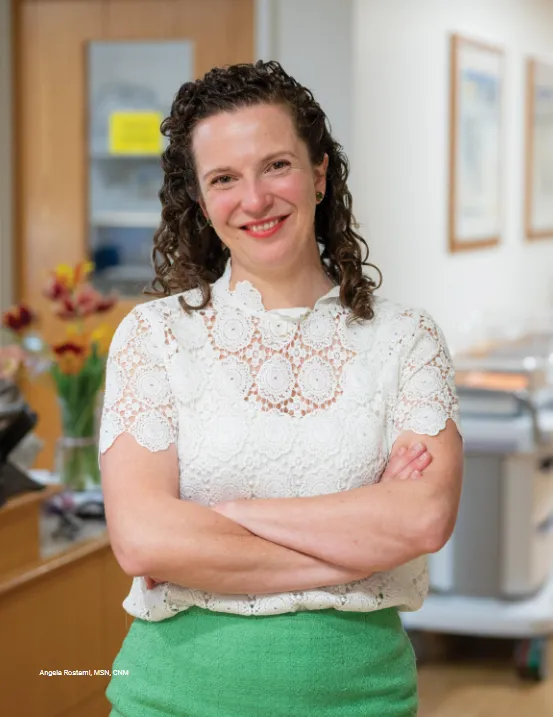
About the Author
Angela Rostami, MSN, CNM, is a Certified Nurse Midwife and the founder of MomSquad. Her clinical experience spans pregnancy, labor and delivery, and postpartum care. Through MomSquad, Angela helps mothers access evidence-aware education, practical preparation, and a supportive community alongside their individual healthcare.
About MomSquad
MomSquad brings mothers together for practical education, preparation, and ongoing connection with other women navigating similar questions and stages of parenthood. Want to talk through questions like this with a midwife and other moms at your stage of pregnancy? See how the Pregnancy Group works.
Got a “big baby” estimate and a lot of questions?
Talk it through with a midwife and other moms at your stage of pregnancy. MomSquad groups form by due date.
Find your MomSquadMedical Disclaimer
This article is for general educational purposes only and is not individualized medical advice. MomSquad does not replace prenatal care, diagnosis, or treatment from a physician, midwife, or other qualified healthcare provider. Talk with your own care team about your personal situation, including how any ultrasound estimate affects your plan.
Sources
- Evidence Based Birth. Big Babies handout (Rebecca Dekker, PhD, RN, 2021).
- Evidence Based Birth. What is the Evidence for Induction or C-section for a Big Baby?
- Evidence Based Birth. Evidence on: Induction for Gestational Diabetes
- Accuracy of antenatal ultrasound in predicting large-for-gestational-age babies: population-based cohort study. American Journal of Obstetrics and Gynecology, 2024.
- Emam D, et al. Usefulness and timing of the third-trimester ultrasound scan. Archives of Gynecology and Obstetrics. 2025;312(5):1445–1459.
- Henrichs J, et al. Effectiveness of routine third trimester ultrasonography to reduce adverse perinatal outcomes in low risk pregnancy (the IRIS study). BMJ. 2019;367:l5517.
- Kiserud T, et al. The World Health Organization fetal growth charts: concept, findings, interpretation, and application. American Journal of Obstetrics & Gynecology. 2018;218(2S):S619–S629.
- Papageorghiou A, et al. International standards for fetal growth based on serial ultrasound measurements: the Fetal Growth Longitudinal Study of the INTERGROWTH-21st Project. Lancet. 2014;384:869–879.
- Rouse DJ, Owen J, Goldenberg RL, Cliver SP. The effectiveness and costs of elective cesarean delivery for fetal macrosomia diagnosed by ultrasound. JAMA. 1996;276(18):1480–1486. PMID: 8903259.
- Sakala C, et al. Listening to Mothers IV. National Partnership for Women & Families, 2026.
- Gardosi J, Ewington L, Booth K, et al. Induction of labour versus standard care to prevent shoulder dystocia in fetuses suspected to be large for gestational age in the UK (the Big Baby trial): a multicentre, open-label, randomised controlled trial. Lancet. 2025;405:1743–1756.
- Landon MB, Spong CY, Thom E, et al. A multicenter, randomized trial of treatment for mild gestational diabetes. N Engl J Med. 2009;361:1339–1348.
- Davenport MH, Hayman M. Physical activity during pregnancy: Essential steps for maternal and fetal health. Obstetric Medicine. 2022;15(3):149–150.
- Written and clinically reviewed by Angela Rostami, MSN, CNM, Certified Nurse Midwife and MomSquad founder.